The inliner is yielding benefits for ZJIT
Originally published on Rails At Scale.
We recently enabled a really cool feature in ZJIT that makes it feel like a Real Compiler™: the inliner! We’ll write more about it soon. In this post, we’ll talk about one excellent concrete benefit we are already seeing and how it optimizes blocks in pretty much every Ruby program.
I’ll start off with a refresher on how blocks work in the Ruby interpreter, then show you how ZJIT understands and optimizes that bytecode, and then show you the impact of the inliner.
Ruby: a refresher
In the beginning, there were loops.
arr = [1, 2, 3]
i = 0
sum = 0
while i < arr.length
  sum += arr[i]
  i += 1
end
People used them to navigate and manipulate variable-length structures, like arrays and strings. This was fine.
Then, in the 1970s, a small group of computer scientists at Palo Alto Research Center invented a programming language called Smalltalk. One of the core features of Smalltalk was that everything was an object and computation was done by sending messages to objects.
This meant that iteration wouldn’t do at all. Instead, we would have to send
the do: message to the array object and pass it a block object.
#(1 2 3) do: [:a | sum := sum + a].
Then, in the 1990s, Matz, inspired by Smalltalk and Perl, created Ruby. We still have “normal” loops but we also have a very Smalltalk-y way of doing it, too:
arr = [1, 2, 3]
sum = 0
arr.each do |a|
  sum += a
end
When this program gets compiled to Ruby bytecode, it ends up looking like a
mostly normal method call to each except that we pass a special kind of
argument to it: a block argument.
To see how this works inside CRuby, we’re going to look at a listing of YARV bytecode—CRuby bytecode. For more on YARV, I recommend Kevin Newton’s excellent Advent of YARV.
Ignore most of the bytecode dump below except for the instruction at 0009,
the send instruction. We are send-ing (see? a message!) each with the
block argument block in <main> (passed a different way than “normal”
arguments, hence the argc:0).
$ ruby --dump=insns /tmp/arrayeach.rb
== disasm: #<ISeq:<main>@/tmp/arrayeach.rb:1 (1,0)-(5,3)>
local table (...)
[ 2] arr@0      [ 1] sum@1
0000 duparray                   [1, 2, 3]                 (   1)[Li]
0002 setlocal_WC_0              arr@0
0004 putobject_INT2FIX_0_                                 (   2)[Li]
0005 setlocal_WC_0              sum@1
0007 getlocal_WC_0              arr@0                     (   3)[Li]
0009 send                       <calldata!mid:each, argc:0>, block in <main>
0012 leave
...continued below...
This block in <main> from the bytecode listing above is the generated name of
the instruction sequence (bytecode) corresponding to the block we passed to
each. Its code, shown below, is the next thing in the bytecode dump. You can
see the usage of local variables sum and a via getlocal and setlocal
variants and also opt_plus, which represents addition (+). Again, the
details are not terribly important:
...continued from above...
== disasm: #<ISeq:block in <main>@/tmp/arrayeach.rb:3 (3,9)-(5,3)>
local table (...)
[ 1] a@0<AmbiguousArg>
0000 getlocal_WC_1              sum@1                     (   4)[LiBc]
0002 getlocal_WC_0              a@0
0004 opt_plus                   <calldata!mid:+, argc:1, ARGS_SIMPLE>[CcCr]
0006 dup
0007 setlocal_WC_1              sum@1
0009 leave                                                (   5)[Br]
$
To make this work, Array has an each method. This each method takes in
its optional block argument and calls it once for every element in the array.
As with most of the core data structures, Array’s methods tend to be written
in C and each is no different. Here is its nice and short definition with
comments added by me:
VALUE
rb_ary_each(VALUE ary)
{
    long i;
    // Some debug-mode-only checks
    ary_verify(ary);
    // If we didn't pass a block in, return an enumerator object
    RETURN_SIZED_ENUMERATOR(ary, 0, 0, ary_enum_length);
    // We passed a block in, so call it for every element
    for (i=0; i<RARRAY_LEN(ary); i++) {
        rb_yield(RARRAY_AREF(ary, i));
    }
    return ary;
}
You can’t really see the block parameter to the C code because it’s passed in a
special location on the Ruby VM’s own stack called the block handler. All you
need to know is that rb_yield knows where to find that and how to call it.
There’s just one more thing, which is… hang on, weren’t we building a JIT to optimize Ruby code? How are we going to optimize this C code?
JITs: a refresher
Rewriting code from C to Ruby means that the JIT compiler gets a chance to introspect the run-time behavior and code. This means that, over time, as the compiler and the runtime system grow together, more and more code might get rewritten in Ruby. This started happening a couple of years ago with YJIT.
YJIT precipitated some interesting changes to Ruby VM internals. For example,
in 2022, Array#each being written in C started to hurt: it was an opaque blob
that the JIT couldn’t reason about. So Kokubun submitted a
PR to rewrite it in Ruby. After some
back and forth, in 2024, Kokubun landed a different
PR that everyone was happy with.
class Array
  def each # :nodoc:
    Primitive.attr! :inline_block, :c_trace, :without_interrupts

    unless defined?(yield)
      return Primitive.cexpr! 'SIZED_ENUMERATOR(self, 0, 0, ary_enum_length)'
    end
    i = 0
    until Primitive.rb_jit_ary_at_end(i)
      yield Primitive.rb_jit_ary_at(i)
      i = Primitive.rb_jit_fixnum_inc(i)
    end
    self
  end
end
Ah, finally. A version that JITs can reason about.
I keep saying “reason about” and what that means concretely here is a) that it’s written in a format that the JIT can ingest and optimize: Ruby, and b) mostly a brief rehashing of the key lessons in the venerable Smalltalk (!) paper Efficient Implementation of the Smalltalk-80 System (PDF):
- Though systems may offer very dynamic behavior, people don’t frequently make
use of wild features all over the place
- Most people pass fewer than 4 types of objects through a given method
- As a corollary, even if there are many classes in a system, code locality is super important, and we can take advantage of that
- Also, most people do not define, re-define, and otherwise continuously modify method definitions
(And if you don’t believe me that the lessons still apply, check out the excellent paper Who You Gonna Call (PDF) by Sophie Kaleba, Octave Larose, Richard Jones, and Stefan Marr.)
So JITs like to watch what types of objects flow through methods before compiling them. And JITs like to, since they know the types of objects, cache method lookups and specialize method invocations on those objects.
For example, take a look at this code:
def next_capacity(x)
  x.length * 2 + 1
end
x could be anything. There is no way of knowing its type by looking at the
code. This means that the length method could be anything. Furthermore, there
is no way of knowing what the return type of x.length is, so we can’t
specialize the method lookups or invocations of * or + either.
But! Per our lessons above, likely only a few types flow through this code. Say
the JIT’s profiler notices that x has historically been an Array. Then we
might reasonably assume that it will continue to be an Array, so when we
compile the method, we add a run-time type check: if the type is no longer an
Array, jump back into the interpreter.
Let’s see what optimized code ZJIT can construct by combining profiling
information with the above bytecode. ZJIT operates on its own high-level
intermediate representation called, uncreatively, HIR. In the following HIR
snippet, we can see this very run-time type check (“guard”) for the Array
class:
fn next_capacity@file.rb:8:
...
bb3(v9:BasicObject, v10:BasicObject):  # v9 is self and v10 is x
  PatchPoint NoSingletonClass(Array@0xdecaf1)
  PatchPoint MethodRedefined(Array@0xdecaf2, length@0xdecaf3, cme:0xdecaf4)
  v35:ArrayExact = GuardType v10, ArrayExact recompile
  v36:CInt64 = ArrayLength v35
  v37:Fixnum = BoxFixnum v36
  # ...
(with real pointers replaced by fake ones for readability)
Because classes are, among other things, collections of methods, this type
information tells us what the call target of x.length is: it’s
Array#length! We have a special fast code snippet to read an array’s length
so we do that instead of a method call.
And in case the methods ever get changed out from underneath us, we leave
behind these markers called PatchPoint that invalidate the code.
Finally, because we know that the result of Array#length is always a small
integer (Fixnum), we can special case the method lookups for * and + as
well.
fn next_capacity@file.rb:8:
...
bb3(v9:BasicObject, v10:BasicObject):  # v9 is self and v10 is x
  PatchPoint NoSingletonClass(Array@0xdecaf)
  PatchPoint MethodRedefined(Array@0xdecaf, length@0xdecaf, cme:0xdecaf)
  v35:ArrayExact = GuardType v10, ArrayExact recompile
  v36:CInt64 = ArrayLength v35
  v37:Fixnum = BoxFixnum v36
  v18:Fixnum[2] = Const Value(2)
  PatchPoint MethodRedefined(Integer@0xdecaf, *@0xdecaf, cme:0xdecaf)
  v41:Fixnum = FixnumMult v37, v18
  v23:Fixnum[1] = Const Value(1)
  PatchPoint MethodRedefined(Integer@0xdecaf, +@0xdecaf, cme:0xdecaf)
  v45:Fixnum = FixnumAdd v41, v23
  CheckInterrupts
  Return v45
There you have it. This is how JITs work: observe, assume, specialize. So why am I telling you all this? How does this circle back to blocks?
Well, blocks work not quite the same way, but similarly. Instead of having an object that we call a method on, we just have the target instruction sequence1. But if we observe that the block argument, in its special location, has been consistently one object, we can specialize the call to it.
This is more or less fine for some cases of code. For example, in the following
code snippet, we only have one caller to custom_iterator, so its profiled
block will be monomorphic (one observed shape).
def custom_iterator
  yield 1
  yield 2
  yield 3
end

custom_iterator do |x|
  puts x
end
This reinforces what we know and love about the Smalltalk-80 paper: code locality wins! Yes!
But unfortunately this falls apart when we start thinking about all of the
core library methods (and potentially the methods and classes you have
stashed away in the grab-bag utils.rb in your application). Those methods are
probably megamorphic (many many observed shapes). They probably see all sorts
of stuff because they are general-purpose utilities that everybody needs, all
the time.
One such example in the Ruby core library is the venerable Array#each
that we saw earlier. Because there are a million different call sites to
Array#each across your application and each probably passes a totally
different block, we’re in an unhappy situation. How can we possibly optimize
for so many different blocks? What happened to our code locality? How do we fix
this?
The code locality is in another tower
It’s okay. Code locality still rules. Look at all the various callers of
Array#each. They all pass a different, but constant2,
block at the call-site:
def method_a(some_array)
  some_array.each do |x|
    puts x
  end
end

def method_b(some_array)
  some_array.each do |x|
    puts x*2
  end
end

def method_c(some_array)
  some_array.each do |x|
    puts x*4
  end
end
So the code locality that we need in Array#each to optimize the code is one
level up at the caller. If we can use that call context, we can specialize
the code.
YJIT accomplishes this by splitting, which is a very natural transformation
for basic block versioning and tracing. Such compilers are good at following
code paths as they would be executed and putting together context across method
calls. However, YJIT’s heuristic for splitting blocks is based on
manual annotations: it will only kick in for certain Ruby library functions
specially annotated with Primitive.attr! :inline_block (and the name is a bit
of a misnomer).
The team that builds ZJIT, a method JIT, decided not to add splitting facilities. We could split methods (and blocks), but we have an easier time reasoning about larger code units than YJIT does because we optimize an entire method at once. So instead, ZJIT chooses to get call context by inlining.
Inlining
Method inlining refers to copying the body of the callee into the caller. In
the above example, it means copying the body of Array#each into each of
method_a, method_b, and method_c. I don’t mean the Ruby code and I don’t
mean the bytecode: I mean the HIR. ZJIT does this by building the HIR of the
callee (Array#each) into the existing HIR of the caller (method_a, …).
The illustrious Kevin Menard wrote ZJIT’s inliner and he’ll write a post about all the details soon. It’s pretty interesting stuff.
For now, we can take a look at the (lightly edited) result of Array#each
being inlined into method_a. The details don’t matter, but there are two
things I want to call out:
- What used to be a dynamic
invokeblockis now what we callInvokeBlockIseqDirectbecause we know from the call context what blockmethod_ais passing toArray#each. - What used to be a method call is now a loop: the condition check is in
bb10, the body is inbb9, and the stuff after the loop isbb13/bb4. If you’re interested, try to find the iteration variable and where it gets incremented. See the footnote3 for the answer.
This is a massive improvement over the previous very generic operations.
fn method_a@/tmp/arrayeach.rb:2:
# ...
bb3(v9:BasicObject, v10:BasicObject):
  # ...
  v55:Fixnum[0] = Const Value(0)
  Jump bb10(v25, v55)
bb10(v68:ArrayExact, v69:Fixnum):
  v73:CInt64 = ArrayLength v68
  v74:Fixnum = BoxFixnum v73
  v75:BoolExact = FixnumGe v69, v74
  v77:CBool = Test v75
  CondBranch v77, bb13(), bb9(v68, v69)
bb13():
  CheckInterrupts
  Jump bb4(v68)
bb9(v90:ArrayExact, v91:Fixnum):
  v96:CInt64 = UnboxFixnum v91
  v97:BasicObject = ArrayAref v90, v96
  v99:CPtr = GetEP 0
  v100:CInt64 = LoadField v99, :VM_ENV_DATA_INDEX_SPECVAL@-0x8
  v101:CInt64[-4] = Const CInt64(-4)
  v102:CInt64 = IntAnd v100, v101
  v103:BasicObject = InvokeBlockIseqDirect (0x16f3d5968), v102, v97
  v107:Fixnum[1] = Const Value(1)
  v108:Fixnum = FixnumAdd v91, v107
  PatchPoint NoEPEscape(each)
  Jump bb10(v90, v108)
bb4(v114:BasicObject):
  PopInlineFrame
  PatchPoint NoEPEscape(method_a)
  CheckInterrupts
  Return v114
You may notice that there is still one call in the loop: the call to the block
(InvokeBlockIseqDirect). That’s next on our list to tackle. We are optimistic
that we will soon also be able to inline block calls. Then the whole thing will
really be just a loop!
The code that enables us to reason about which block got passed into the
inlined callee (Array#each) only landed a couple of days
ago
(July 10, 2026), written by Luke Gruber. This
was one of Luke’s first changes to ZJIT.
So what does performance look like?
Well, for starters, the microbenchmarks that we use as “performance unit tests” for specific aspects of Ruby went wild. Some benchmarks that were using block-based looping got much faster; they were previously bounded by ZJIT’s block invocation performance.
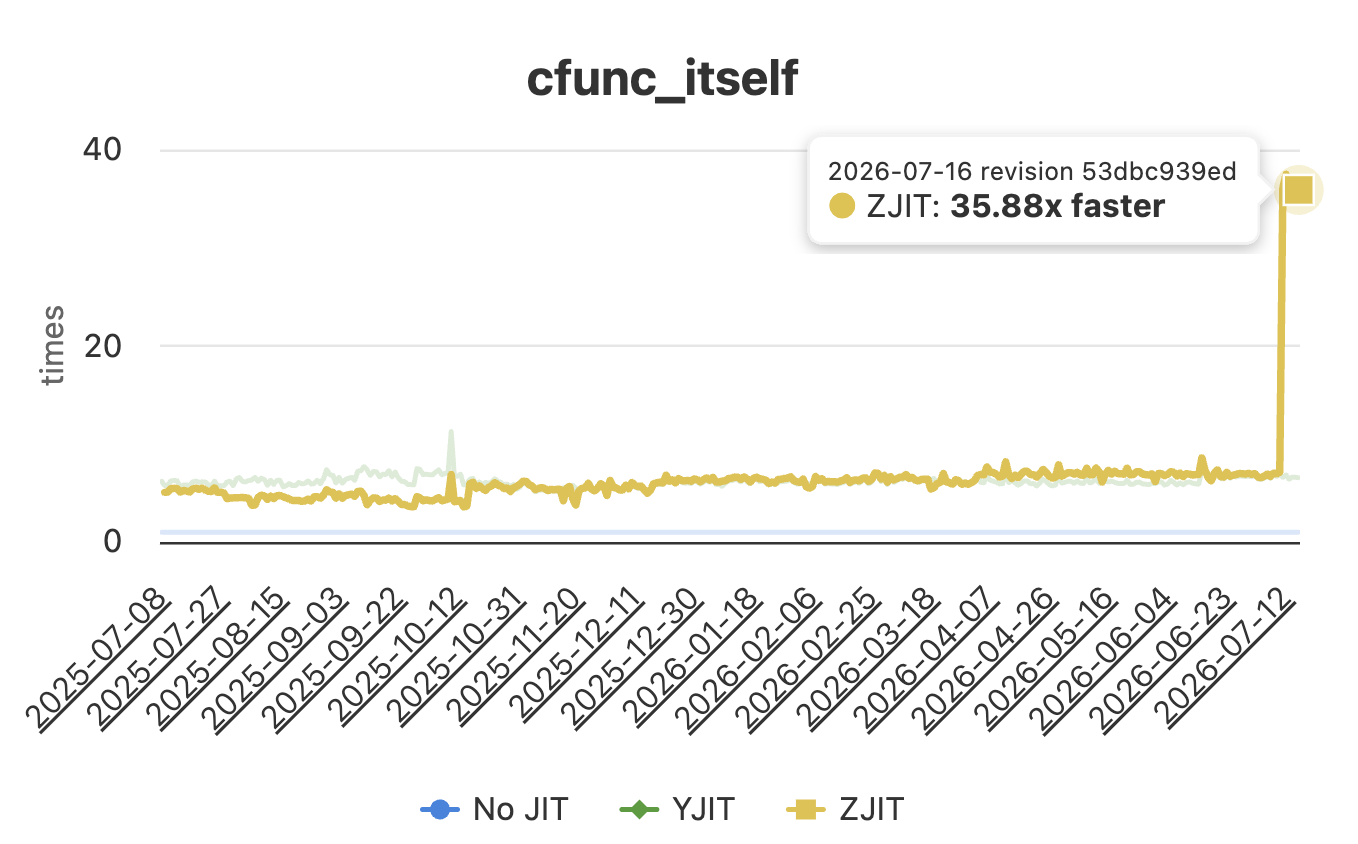
Take a look at the cfunc_itself benchmark, which tests that we can fold away
the call to Ruby’s built-in itself method. ZJIT ends up optimizing the
times method to invoke the do block directly, and the do block gets
optimized to nothing but a guard on the self’s class to make sure it hasn’t
changed.
run_benchmark(500) do
  500000.times do |i|
    itself
    itself
    itself
    itself
    itself
    itself
    itself
    itself
    itself
    itself
  end
end
Because we had previously optimized the body away, the result of the direct block invocation is a massive speedup:
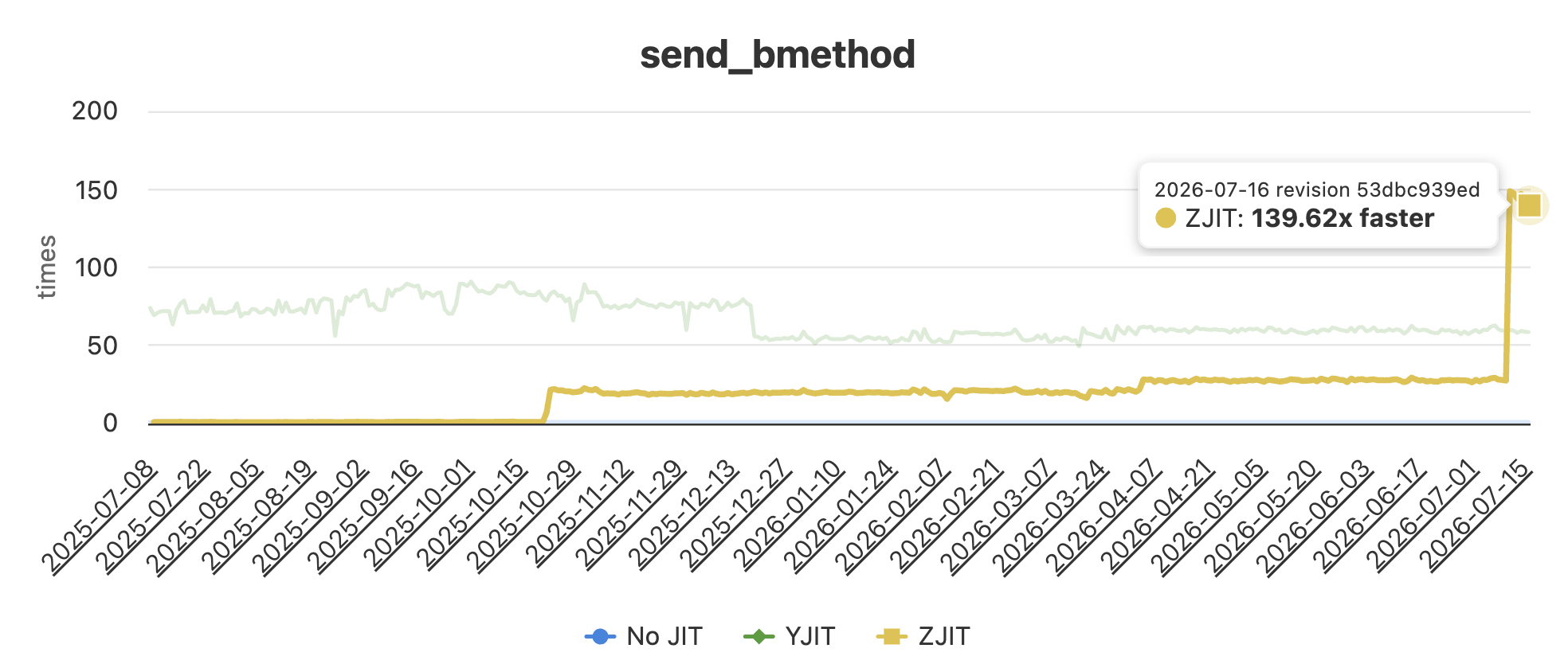
Other benchmarks also kind of stop making sense because of the amount of
inlining. Our bmethod benchmark, which benchmarked how fast we can call methods
defined with define_method, also stopped measuring anything of use. We’re
going to have to rework the benchmark to be more fair…
As expected, larger Rails benchmarks don’t see a ton of change; they exercise a diffuse set of features so optimizing any one feature bumps the big benchmarks only a little bit.
I am excited to see what happens when we can fully turn each and friends into
call-less loops!
Wrapping up
Code locality rules. The inliner helps inject more of it and reason across method calls. ZJIT, a little over one year old, is growing up! :’)
We’re still tuning the inliner knobs. Some of the code in this post required
tweaking --zjit-inline-threshold to convince the compiler to inline
Array#each into method_a because of Array#each’s size. It will take some
time for the ZJIT developers to figure out reasonable defaults.
Try out our HIR explorer at tryzjit.fly.dev. Try
out ZJIT in your application by adding the --zjit flag to a Ruby over 4.0.
Thanks for reading and see you next time.
-
Mostly. I am glossing over
nil, procs, ifuncs, etc. But the common path is by and away iseq blocks. ↩ -
It’s not always the case that these methods are called with a constant block iseq. Sometimes they are called with the
&:symbolform, for example. Or with the&some_block_variableform. In that case, we can use an inline cache to (with a guard) make it constant once more. But we have not implemented that yet, because it is rarer. ↩ -
The iteration variable is
v91! You can see it get used as an array index when it gets unboxed asv96and passed toArrayAref. You can also see it get incremented withFixnumAddand the constant1. Inbb10it has a different name,v69, which gets checked against the array length. ↩